
Ford’s Answer to China: A Completely New Way of Making Cars Leave a comment
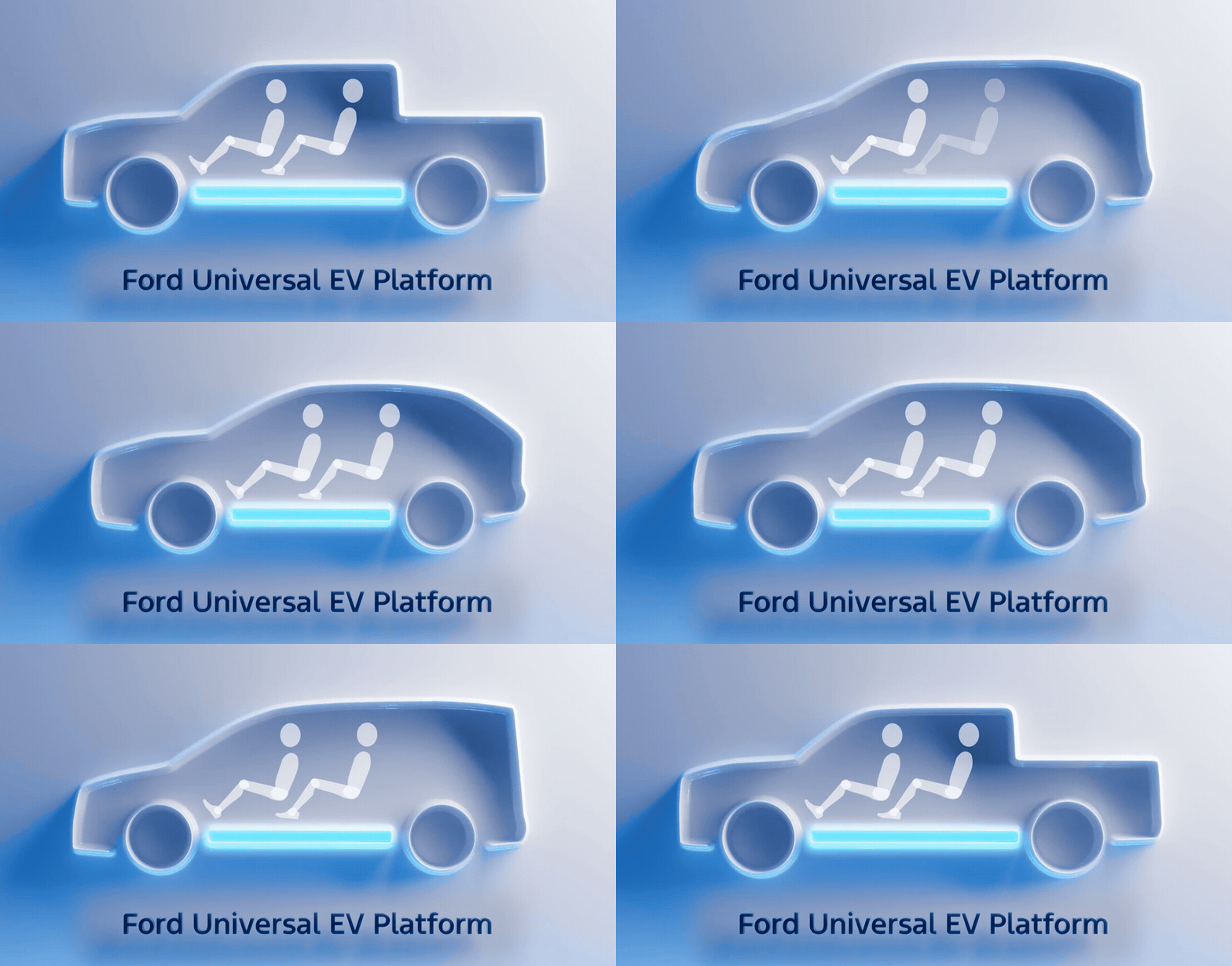
“We construct a structural battery out of the cells, and that’s the ground of the car. So we truly constructed the seats on it,” says Subject. So, to be clear, there is not any body or construction with a battery on high of it to which the seats are bolted—with Ford’s new mannequin the battery is the construction. How does this differ from present cell-to-chassis or cell-to-pack expertise? “That is cell-to-body,” says Subject, including that making this all work was very, very arduous.
“There isn’t any single magic breakthrough. It is simply actually, actually arduous engineering,” he says. “And there is a entire bunch of issues to be solved. Like, now you might have this physique that has no ground, how do you retain it from bending because it goes down the road? How do you cope with the paint whenever you’ve painted the again half, however you have not painted the entrance half, after which you are going to bolt them collectively on the finish?”
“We knew we wished to construct EVs in a different way, and we determined how we wished to construct them—then we obtained a big set of engineering issues we needed to go remedy to make that work.” The worst of those issues? “Becoming a member of the entrance finish. Sealing, crash [strength], corrosion, dimensional accuracy—all of these issues, doing these on the finish is … that entrance finish joint is certainly probably the most tough.”
Sure, a lot of that is catching up with state-of-the-art stuff for EVs, equivalent to zonal structure the place completely different capabilities are managed in several components of the automobile, which you’ll already see within the new Tesla Mannequin Y and lots of China EVs. Equally, giant aluminum castings are already being utilized by Tesla and Chinese language makers.
Nevertheless, if Ford has genuinely managed to construct a automobile in three distinct modules, that are accomplished absolutely and solely then bolted collectively, that may be a real first. Sure, Tesla talked about doing one thing like this again in 2023 with its “unboxed” EV manufacturing course of, but it surely hasn’t carried out it but. In different phrases, Ford could have overwhelmed Tesla to the punch right here. The outdated dinosaur has became fairly the velociraptor.
Nearly as spectacular as Ford’s new modular manufacturing is the variety of individuals and sheer velocity with which the corporate has achieved this simple win. “What’s actually fascinating is the scale of the crew [the skunkworks had] in comparison with what if Ford had to do that,” says Farley. “If we pressured [Ford] do it, it will have taken 5 instances the individuals.”
“Once we agreed to begin this system, three years in the past, we employed Alan Clarke. He went right into a constructing, and it was one individual. That is how the mission began,” says Subject. Alan Clarke labored for Subject at Tesla, the place he helped create the Mannequin 3, labored on the Y, the Cybertruck, and extra. “There’s individuals in China now who most likely have handed him, however on the time he had architected extra electrical automobiles than anyone on the earth, so he was completely the correct individual to faucet. And he is additionally a expertise magnet. He is constructed the crew actually rapidly—a world-class crew. Lots of people who’re tremendous excited to maneuver from a Rivian or a Tesla and construct one thing for Ford.”
Farley thinks that Ford’s new means of constructing EVs is the right weapon to tackle the Chinese language automakers, the best instance of exactly how the West must compete. “You have obtained the BYD mannequin: 700,000 workers, 200,000 powertrain engineers. How do you beat them?” asks Farley.
“Seems, Doug and Alan and the crew constructed a propulsion system that was like Apollo 13, managed right down to the watt in order that our battery could possibly be a lot smaller than BYD’s. Their value benefit on vertical integration on the battery is offset by innovation within the powertrain. We will not beat them on scale. We will not beat them on vertical integration. However we will beat them on innovation.”
