
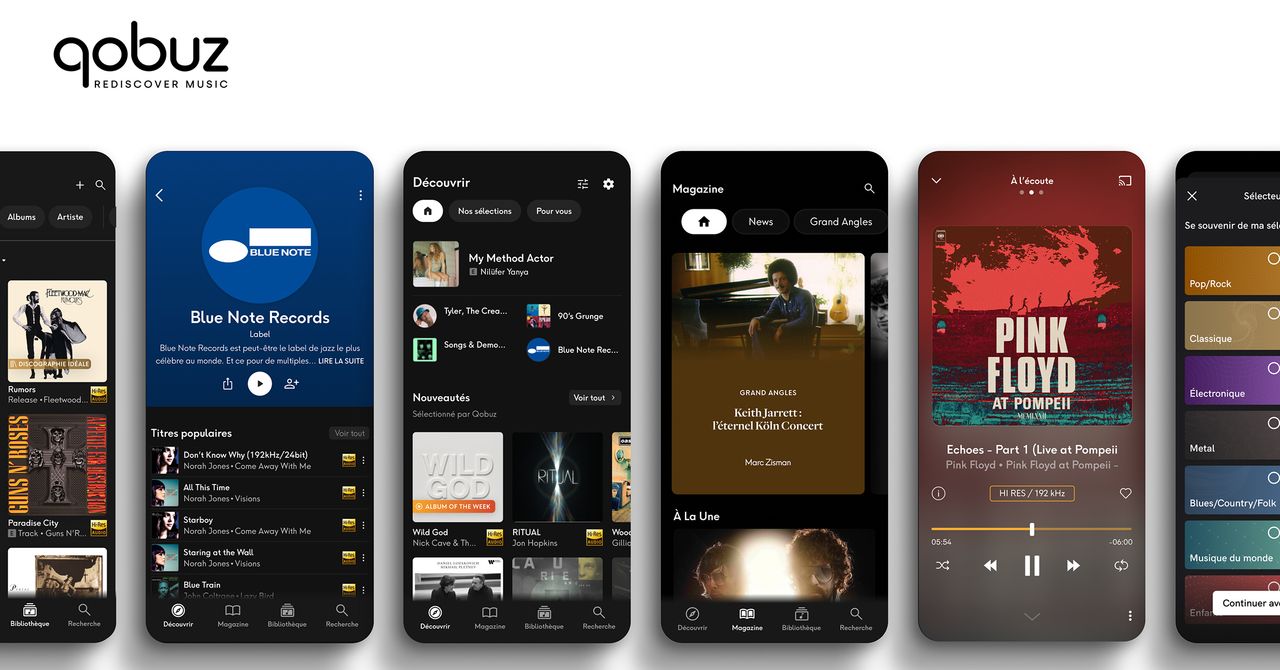
Qobuz Is the Anti-Spotify Music Streamer You’ve Been Waiting For Leave a comment
When Dan Mackta, Qobuz’s New York–based mostly managing director, was in search of musicians to endorse the music streaming service after its US launch in 2019, he tapped up a buddy—the supervisor of the Flaming Lips. It was mid-pandemic ranges of tough.
“I flew to Oklahoma to shoot with Wayne Coyne,” Mackta says. “He exhibits up sporting a kind of helmets, with the air flow system to guard you, a metallic puffer jacket and massive silver moon boots.” They couldn’t hear a phrase Coyne stated within the helmet, so the frontman went dwelling and shot the promo video himself: “The right way to pronounce this bizarre phrase ‘ko-buzz.’”
The Qobuz questions after “How do you say it?” are seemingly “Can I switch my music library throughout?” and “Does it have the whole lot?” The solutions: sure and virtually. Living proof: I not too long ago switched to Qobuz, after practically 20 years with Spotify. (Emotional.) I used a third-party service known as Soundizz to switch my songs; it took half a day to port, with a greater than 90 p.c hit charge for my playlists.
One Million Membership
I am not alone, based on Mackta, who landed at Qobuz after years at main and indie report labels—2025 was a banner yr for the 19-year-old firm. Twelve months in the past, Qobuz had round 500,000 subscribers. The French streamer had grown steadily since 2007, focusing on “individuals who already knew what hi-res music was” with its 100 million–plus catalog of lossless CD-quality and 24-bit music.
The primary winds of change arrived with Liz Pelly’s January 2025 e book Temper Machine, which criticized Spotify’s enterprise practices, that includes interviews with former workers and artists calling for fairer trade economics. As Mackta places it, “This isn’t a music firm; music was only a means to an finish.” It renewed the scuttlebutt amongst artists about low payouts, and Qobuz’s day by day US trial numbers began to choose up.
In mid-October, free-tier customers began posting the ICE recruitment advertisements they noticed on Spotify, which went viral on TikTok and Instagram Reels. “The day that story broke was our greatest day ever within the US,” Mackta says. Qobuz noticed one other spike in numbers, plateauing till Spotify’s personal advertising satisfied extra individuals to modify in early December. “The second finest day was Spotify Wrapped,” he says. Qobuz hoovered up everybody from audiophiles and “aware shoppers” responding to boycotts like Demise to Spotify and Indivisible, to Ok-pop superfans looking for high-quality downloads.
Qobuz now has 1.2 million energetic month-to-month customers, and its streaming income shot up 45.7 p.c in 2025, in comparison with 8.8 p.c progress in general paid music streaming. Round a 3rd of its income now comes from the US, its greatest market. These are nonetheless teeny numbers subsequent to Spotify (293 million paid subscribers) and Apple Music (greater than 100 million). “For us to say we’re gonna compete with Apple or Amazon,” Mackta says, “we’d as nicely say we’re making an attempt to launch a rocket.” Qobuz’s purpose is to succeed in 1 p.c of the paid streaming market; below its French CEO Denis Thébaud, it expects to succeed in profitability by March 2027.
Increased Payouts
For years, Qobuz had popped up in posts by artists bemoaning being paid “1 / 4 of a cent per stream” on large platforms versus “a a lot increased quantity” on Qobuz. Wading into digital cost buildings to labels and rights holders can get murky, with low transparency, imprecise payout ranges and, identical because it ever was, conflicts between labels and artists. However in a number of evaluations and artist anecdotes, Qobuz has the best pay-per-stream, edging out rival hi-res music service Tidal and, in some circumstances, paying out 5 to 6 occasions as a lot as Spotify.
A mean per-stream charge is a synthetic metric, which doesn’t mirror how everybody will get paid. However in March 2025, the corporate launched that all-important quantity, verified by an unbiased auditor: Qobuz pays a mean of $0.01873 per stream, or $18.73 per 1,000 streams. “We knew we had one of the best quantity so we thought we’ll simply lay it down,” Mackta says. “Anybody else wish to inform us what theirs is? They don’t.” Spotify’s common per-stream vary is round $0.003 to $0.005 per stream, or $3 to $5 per 1,000 streams.
